
What Really Changes When Hiring Developers in the AI-Native Era
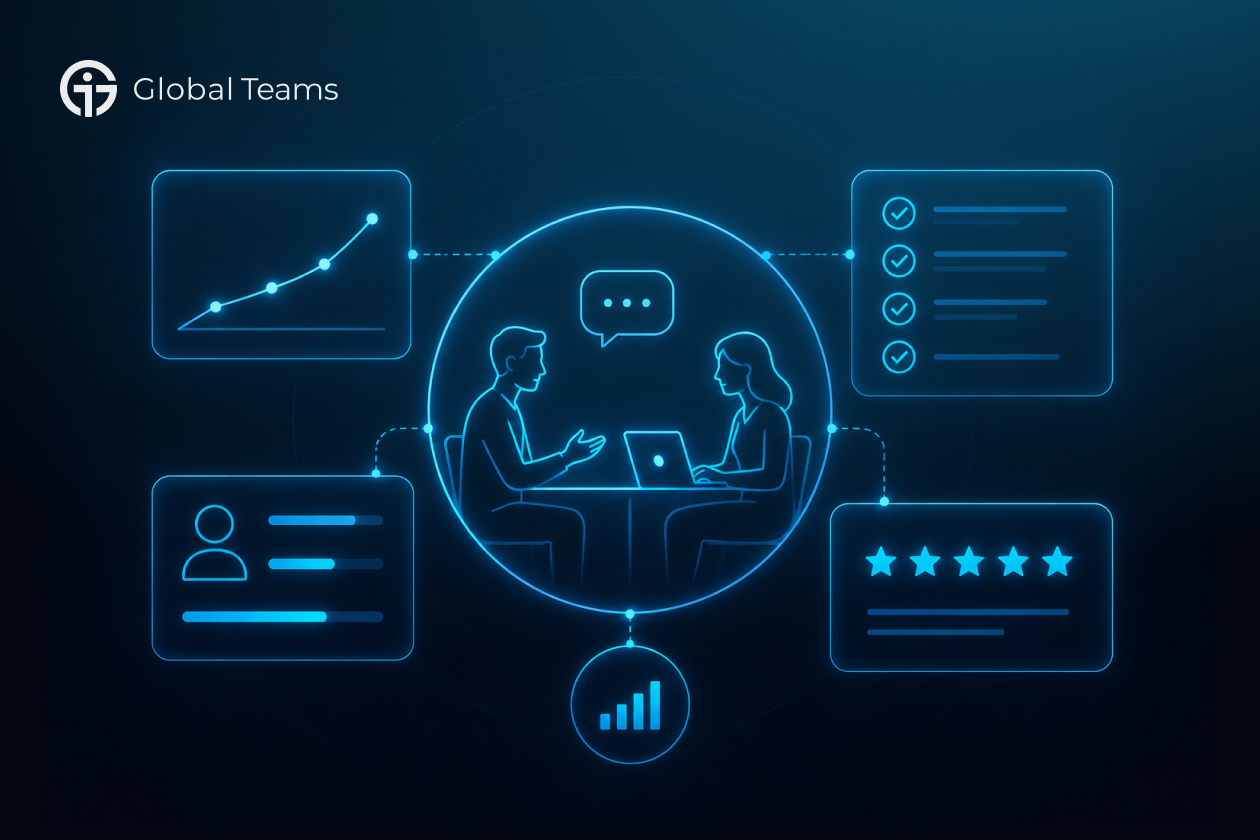
We used to ask developers in a job interview whether they work with AI tools. Today that question has become meaningless, roughly like asking a candidate whether they work with a keyboard. Almost every developer will answer yes, and rightly so — using AI tools has become the taken-for-granted backdrop of the profession, not a distinguishing skill. And yet many companies keep asking the old question and receiving an answer that teaches them nothing.
The fact that almost every developer uses AI does not mean that all developers are AI-native. The opposite is the case: precisely because usage has become universal, the interesting question is no longer whether someone uses AI, but how. And that is exactly what is reshaping technical hiring.
Why the Old Question About AI Tools Lost Its Meaning
The data tells the story clearly. According to the Stack Overflow Developer Survey for 2026, conducted among more than 30,000 professionals, only a small minority of developers do not use AI tools at all. Two-thirds use coding assistants or coding agents, and a significant share of them do so for long hours each day. In such a reality, a question like “do you work with Copilot?” no longer filters between candidates — it simply confirms what is true for almost everyone.
When a skill becomes universal, it stops being a screening criterion. The value of an interview question is measured by its ability to distinguish between candidates, and a question everyone answers the same way does not do that. So organizations that keep focusing on the tools question find themselves hiring by a criterion that no longer separates strong from weak.
The Danger of Hiring by Familiarity With Tools
Clinging to the old question is not merely inefficient — it can be actively misleading. When an organization hires by familiarity with AI tools, it gives an advantage to candidates who know how to talk about the tools, not necessarily to those who know how to use them with judgment. A candidate can reel off the names of dozens of tools, display fluency in the latest trends, and still be a developer who accepts every AI output without checking it. Broad familiarity with tools is no indication of decision quality — at times it even hides its absence.
The result is a quiet bias in the hiring process. Organizations that keep measuring familiarity with tools screen in those who speak well about AI, and may miss precisely the strong candidates — those who use the tools intensively but speak about them cautiously, out of awareness of their limits. In a world where almost every candidate “works with AI,” this criterion does not separate the good from the less good, but rather those who market themselves well from those who do not.
The conclusion is not that familiarity with tools is worthless, but that it is a threshold condition and not a differentiating factor. Once almost everyone meets the threshold, the distinction has to move elsewhere — to the way the candidate thinks, judges, and decides around the tools they know.
What Really Distinguishes an AI-Native Developer
If not the tools, then what? The difference between a developer who uses AI and an AI-native developer lies almost entirely in one domain: judgment. An AI-native developer is not the one who produces the most code with AI, but the one who knows exactly when the tool serves him and when it endangers him. He recognizes output that looks correct but is wrong, understands where the AI tends to err, and knows at which stages of the process it must not be allowed to touch.
The data supports this picture. The same survey shows that developers trust AI output mainly when they can easily verify it, that the vast majority attach great importance to being able to know where an answer came from, and that a large share of them revert to human oversight the moment trust is shaken. In other words, strong developers have already developed an entire system of judgment around AI — and it is exactly that system organizations need to learn to identify.
The Skill That Moved to the Center: Judgment
Judgment was always important in software development, but in the AI-native era it moved from a secondary skill to a central one. The reason is simple: when writing the code itself becomes cheap and fast, the bottleneck moves to decisions. What is worth building, which output to accept and which to reject, where speed is worth the risk and where it is not — these are the decisions that determine the quality of the product, and they all depend on human judgment.
From this follows a deep change in the ideal candidate profile. Less weight on the question “how fast do you write code,” and more weight on the question “how well do you decide what to write, and when to stop.” This is a skill that is harder to measure in a questionnaire or a standard technical test, but it is the one that best predicts performance in a work environment where AI is present at every stage.
It is worth emphasizing that judgment is not an innate trait you either have or lack — it is built out of experience and exposure. A developer who has worked across a variety of contexts, who has seen architectural decisions succeed and fail, and who has absorbed feedback on his choices, arrives with more developed judgment than one who knew only a single environment. So when an organization examines judgment in an interview, it is in effect examining the depth of the candidate’s experience and his ability to learn from his professional history — two things a list of tools does not reveal at all. It is also a more durable measure over time: tools change every few months, but good judgment stays relevant even as the technology beneath it shifts.
How This Changes the Essence of Interview Evaluation
The change is not the addition of another question to the list, but the replacement of the entire focus of evaluation. Instead of asking which tools the candidate knows, advanced organizations are interested in how he thinks about them. Instead of checking whether he uses AI, they examine how he relates to its output — whether he takes it for granted, or holds it critically.
A conversation about a real case in which a candidate chose to reject code the AI suggested, and about the reasons for doing so, teaches far more than any list of tools. So does a conversation about the stages in the process where the candidate deliberately chooses not to rely on AI. These are not technical questions in the narrow sense, but windows into judgment — into the ability to navigate between the places where the tool adds value and those where it adds risk. The difference between old hiring and new lies exactly there: not in what the candidate knows, but in how he judges.
It is worth noting that this shift does not make technical ability less important. A deep understanding of systems, architecture, and engineering principles is precisely what enables good judgment about AI output — it is hard to know when the tool is wrong without understanding the domain in depth. What changes is that technical ability is now examined through the prism of the decisions it enables, rather than as an end in itself.
What This Means for Building a Global Team
The understanding that judgment is the distinguishing skill also changes how teams are built. When the goal is not merely to fill roles but to bring AI-native ways of working into the organization, hiring becomes a strategic tool. A developer who already arrives with well-developed judgment about AI is not just another pair of hands — he is a source of work norms the existing team can learn from.
So many organizations discover that the fast way to embed AI-native thinking is not through training but through people. Building a global team that integrates talent already working this way, alongside a strong local core that holds the business context, makes it possible to transfer the way of working as a living practice rather than a theory. This is a move that begins with hiring but has influence far beyond the individual role.
Conclusion: Not What You Know, but How You Judge
Technical hiring is undergoing a quiet but deep change. The question of whether a developer uses AI no longer teaches anything, because almost everyone answers it the same way. The skill that has moved to center stage is judgment — the ability to know when to trust the tool and when to stop it. Organizations that keep checking familiarity with tools will hire by a dead criterion. Those that learn to identify judgment will hire the developers who are truly ready for work in the AI-native era.
Frequently Asked Questions
Which questions reveal AI-native judgment in an interview?
Questions that focus on decisions rather than tools. For example, asking the candidate to describe a real case in which they chose to reject output the AI suggested and the reasons for it, or a question about the stages of the process where they deliberately choose not to rely on AI. Answers to such questions reveal the quality of judgment far more than any list of tools the candidate knows.
Is technical ability still important in the AI era?
Very much so. A deep understanding of systems and architecture is exactly what enables good judgment about AI output — it is hard to know when the tool is wrong without understanding the domain in depth. What has changed is that technical ability is now examined through the decisions it enables, rather than as an end in itself.
How do you integrate an AI-native developer into an existing team?
Beyond ordinary onboarding, the greatest value is in exposure: letting the existing team see how the new developer plans, checks output, and decides when to stop the AI. The way of working passes through shared practice — code review, planning, and daily conversation — not through formal training.
Do you need a different technical test in the AI era?
Not necessarily a different test, but a different emphasis. Instead of checking only the speed of writing code, it is worth including situations that reveal judgment — for example, evaluating a solution produced with AI assistance and identifying where it is wrong. The goal is to measure how the candidate judges, not only what he produces.
Can junior developers be AI-native?
Yes, but the challenge is different. Developers early in their careers often command the tools naturally, but judgment about when not to rely on them is built with experience. So for them, exposure to working alongside more experienced developers is especially important, as it is from this that they absorb the decisions and boundaries. They are not “less AI-native” by virtue of their age, but are at an earlier stage in building judgment.
About Global Teams
Global Teams focuses on linking top-tier technical professionals to forward-thinking organizations worldwide. With our unique recruitment approach, frameworks for cultural integration, and management strategies aimed at retention, we help companies assemble high-performing, AI-native technical teams while achieving 40–60% cost savings. Arrange a consultation with our technical talent strategists for a tailored talent acquisition plan.