
Local Outsourcing vs. Offshore Outsourcing: What You Actually Need to Know Before Deciding
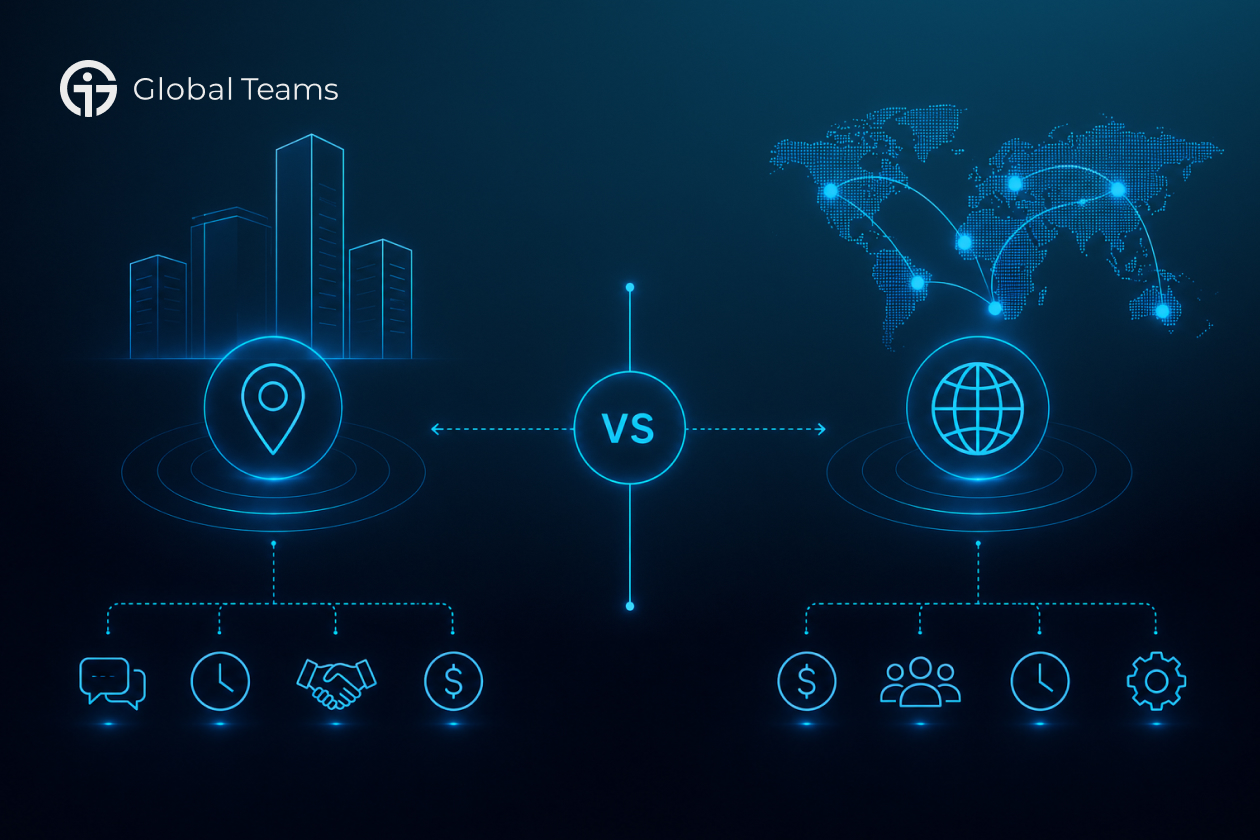
When to keep things at home, when to look abroad, and how to choose the model that genuinely fits your startup or company.
The question “local or offshore?” has resurfaced as one of the most common topics in conversations with R&D leaders and CTOs over the past year. Not because outsourcing is a new concept — it has existed for decades. The reason is that the underlying economic and strategic equation has fundamentally shifted. Developer salaries in major tech hubs have reached levels that strain even well-funded companies attempting to hire at scale, remote work models have become the industry default, and entirely new talent markets have become more accessible than ever before.
Yet within all this deliberation, there is persistent confusion between two concepts that are often treated as if they were interchangeable: local outsourcing (also called onshoring) and offshore outsourcing. They look similar on the surface but operate in fundamentally different ways, and choosing the wrong one can cost your company far more than the budget gap you were trying to close in the first place.
Defining the Terms: What Each Model Actually Means
Before diving into comparison, precision matters. Both terms belong to the same family — models for procuring development services or operations from an external party — but they diverge along geographic and strategic lines.
Local Outsourcing (Onshoring)
In this model, your company hands tasks, projects, or entire development teams to an external provider operating in the same country — sometimes even in the same city. In practice, this means partnering with a local software house, development agency, or domestic outstaffing firm. The language is the same, the business culture is the same, and often the specific developers carry the same nationality and operate under the same labor framework as your internal team.
Offshore Outsourcing
Here, you work with a provider or team based in another country — sometimes adjacent, sometimes on an entirely different continent. The team might be in Poland, Romania, Ukraine, India, Colombia, or the Philippines. The core difference is not only geographic: it is cultural, legal, financial, and, of course, budgetary.
Beyond these two models, it is also worth knowing the term nearshoring — outsourcing to a country that is geographically close or operates within a similar time zone. For companies based in Western Europe or the Middle East, Eastern European countries (Poland, Romania) or Mediterranean basin countries (Portugal, Greece) are typically considered nearshore.
The Substantive Comparison: 7 Dimensions That Matter
Average hourly cost: With local outsourcing, costs are high and tracked closely with the domestic labor market. With offshore outsourcing, costs are 40–60% lower depending on the country.
Language and cultural gaps: With local outsourcing, gaps are essentially nonexistent — the same language and the same business culture. With offshore outsourcing, gaps vary, and cultural onboarding requires deliberate investment.
Time-zone differences: With local outsourcing, there is no gap — the same time zone. With offshore outsourcing, the difference can range from 2 to 12 hours depending on location.
Contractual and legal complexity: With local outsourcing, this is straightforward and operates within domestic law. With offshore outsourcing, complexity rises significantly — local labor regulations need to be understood and respected.
In-person meetings: With local outsourcing, meetings are easy to organize. With offshore outsourcing, they require advance planning and travel costs.
Talent pool size: With local outsourcing, the pool is constrained to the domestic market. With offshore outsourcing, the pool is dramatically larger — global access.
Hiring speed: With local outsourcing, hiring is slow and dependent on a tight market. With offshore outsourcing, hiring is fast — ready-to-deploy teams can be available within weeks.
The Advantages of Local Outsourcing — and Their Real Cost
The most obvious advantage of working with a local provider is that there is virtually no cultural learning curve. When a team in one city hands a project to a software house in the same metropolitan area, the conversation happens in the same language, with the same business mentality, and against the same calendar of holidays and quarterly rhythms. Local teams instantly grasp context like “we need this urgently before the end of the quarter” or “the CEO asked for this to be ready before the conference” — nuances that would take months to embed in a foreign team.
In addition, in-person meetings, office visits, and collaborative planning sessions are simple to organize. If there is a critical production issue, you can be in the same room within an hour.
But this advantage comes at a price. The hourly cost of a developer through a local provider is not far from the cost of internal hiring — sometimes even higher, because the provider adds a margin on top. For a seed or Series A startup, this gap can be the difference between an 18-month runway and a 12-month one.
The Advantages of Offshore Outsourcing — and the Challenges
The primary reason companies turn to offshore outsourcing is, of course, cost savings. A senior backend developer in Poland can cost 40–50% less than their counterpart in a top-tier hub, and in India or the Philippines — even less than that. But this is only half the picture. The second advantage, often more important than price, is access to talent.
Mature local tech markets are small, dense, and competitive. If you are searching for a specialist in a specific domain — an ML engineer with hands-on experience deploying LLMs in production, a DevSecOps expert, or a senior data architect — the probability of finding them readily available locally is significantly lower than in the Polish, Ukrainian, or Indian markets. There are simply more people there, with greater depth in niche disciplines.
“For large enterprises, offshore is an option. For growing startups, it is often the only way to build a serious development team without burning through the cap table.”
The downside? The adaptation curve. For a remote team to function well, your company must invest in a structured and documented onboarding process — not “sit next to me for a week.” A culture of asynchronous documentation is also required, leveraging tools like Notion, Loom, and Confluence rather than relying solely on Slack. A minimum overlap of four hours of working time is critical — below this threshold, efficiency drops sharply. You need a direct manager who genuinely knows how to operate remotely, because not every manager is suited to it. And finally, investment in physical face-time — one or two in-person visits per year — produces measurable returns on retention and team cohesion.
When to Choose Local vs. Offshore
There is no single correct answer — the choice depends on the type of project, the stage of the company, and the nature of the team you already have in place. Here is a practical decision framework:
Local makes more sense when: the project is short, urgent, and business-critical; deep integration with the existing team is required; there are regulatory constraints (defense, government, certain financial verticals); you are still in product discovery with frequent direction changes; or the project carries significant intellectual property sensitivity.
Offshore makes more sense when: you are building a team for a 6 to 24-month horizon or longer; budget is a primary constraint; you are looking for niche expertise unavailable locally; you have mature documentation and management processes; or you want a “follow-the-sun” 24/7 development model.
The Common Mistake: Treating This as a Binary Decision
One of the most frustrating decisions tech leaders make is the sweeping commitment — “we work only locally” or “our entire team is offshore.” In reality, the tech companies that build healthy operations over the long term consistently choose a hybrid model: a local core team comprising key roles, architects, and culture leaders; an offshore execution layer made up of developers, QA engineers, DevOps, and data engineering; and targeted strategic partners brought in for specialized work under time-bound contracts.
This division is not arbitrary — it balances cultural control, response speed, and operational cost. A strong local core team preserves the product’s DNA, while a well-structured offshore execution layer enables you to scale quickly and stay within budget.
Questions to Ask Yourself Before Deciding
Is my product well-defined? If you are still in market discovery, do not move to offshore at this stage — you will get stuck in iteration loops.
Do I have a technical manager capable of operating remotely? Without one, an offshore project will end in frustration.
What is my budgetary horizon? A 3-month project — local. 18 months and beyond — offshore.
Which roles am I actually looking to fill? Strategic roles — local. Execution roles — offshore can work beautifully.
What is the level of intellectual property risk? If your product is a proprietary algorithm, strong NDAs and a properly structured partner are essential.
What a Realistic Cost Calculation Looks Like
One of the most consistent mistakes in this comparison is to look only at the hourly rate. A realistic calculation includes considerably more.
In addition to direct cost, a proper calculation accounts for: the management time of the CTO or VP of R&D (typically 10–20% of their bandwidth), onboarding investment (a full month or two for senior roles), communication and documentation tooling (Notion, Linear, Loom — roughly $50–$100 per employee per month), travel and in-person meetings ($1,500–$3,000 per person per year), and the overhead of replacement hiring in the event of departure (150% of annual salary, according to industry averages).
Even after all the ancillary expenses are accounted for, the offshore model still comes out significantly cheaper — but the gap is not the headline 60% that appears in vendor presentations. It is closer to 25–40%. That is still substantial savings, but it is important to enter negotiations with calibrated expectations.
The Bottom Line: Don’t Choose — Integrate
The real question should not be “local or offshore?” but rather: “what is the right combination for my team, my product, and my budget at this stage?” The companies that succeed in this market are those that understand it is not a zero-sum game. A strong local team provides cultural stability, while well-chosen offshore partners provide speed and budget flexibility. The integration of the two is the genuine competitive advantage.
If you are facing this decision right now, here are the first concrete steps. First, map your existing team — identify which people are strategic at a level that should remain in-house, and which roles can lend themselves to distributed work. Second, select 2–3 providers — one local, and one or two nearshore or offshore — and begin a limited 3-month pilot. Third, define success metrics in advance: output quality, response speed, team morale, and total cost. Only after three months of real execution will you be in a position to make a data-driven decision.
In 2026, the ability to build a flexible team that combines the best of both worlds has become one of the most important competitive advantages in tech. The choice between local and offshore is not a single decision — it is a sequence of decisions that evolves alongside the growth of the company.